

The Book Behind a Familiar Name
Tafsir Ibn Kathir is often the first substantial Qur’an commentary a Muslim encounters. Its Arabic title is Tafsir al-Qur’an al-‘Azim, and its author, Isma‘il ibn ‘Umar ibn Kathir, approaches revelation through a recognizable order of evidence. He connects verses with other verses, then draws on prophetic hadith and explanations transmitted from the earliest Muslim generations.
This approach is commonly described as interpretation grounded in transmitted sources. It does not exclude reasoning, language, or legal discussion. Rather, it gives priority to revelation and the understanding inherited from those closest to its original setting. Ibn Kathir also compares reports and discusses questions about their reliability. [1]
That distinction matters when we read a moving story in a commentary. The fact that a report appears in a respected classical book does not automatically establish every detail as authentic. Ibn Kathir sometimes records material in order to examine it, question it, or explain why stronger evidence should take precedence.
Learning to Read Verses Together
A helpful example appears in his explanation of Al-Fatihah. When the surah asks for the path of those favored by Allah, Ibn Kathir connects it with Al-Nisa 4:69, which identifies the prophets, the truthful, the martyrs, and the righteous among those favored. One Qur’anic passage clarifies another. [2]
This habit changes the way we approach a verse. Instead of treating it as an isolated sentence, we begin to notice its relationships across the Qur’an. A brief expression may receive fuller explanation elsewhere. A passage that initially raises a question may be illuminated by another passage dealing with the same subject.
Ibn Kathir also draws on the Companions and their students, discusses legal disagreements, and addresses narrative material associated with earlier religious traditions. His handling of such material requires care: details neither confirmed nor contradicted by revelation should not be presented with the certainty owed to the Qur’an or an established prophetic report.
Choosing an Edition and Reading Well
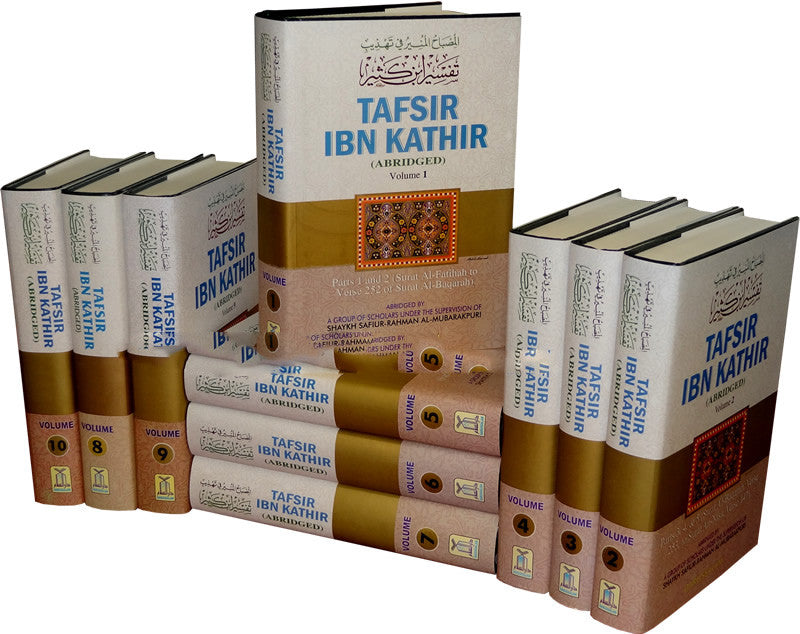
The familiar English ten-volume set sold by HilalPlaza is an abridged presentation, based on an Arabic abridgment prepared by a scholarly team. It covers the whole Qur’an, but it should not be confused with a complete translation of every discussion in the original Arabic work. Volume count alone does not establish completeness. [3]
For an ordinary reading routine, we can begin with verses we already recite frequently. Read the passage, study its explanation, and identify one connection that improves understanding. Keeping a small record of these connections can make daily recitation more attentive without turning each session into an overwhelming research project.
More technical matters deserve further study. Disputed legal questions, assessments of narrators, and difficult theological passages benefit from explanation by knowledgeable teachers. The book’s popularity should encourage us to learn its method, rather than assume that a few lines settle every scholarly disagreement.
The lasting value of Tafsir Ibn Kathir is its invitation to understand the Qur’an through evidence before drawing personal lessons. Reflection becomes richer when it begins with a sound understanding of the text. We can then ask a more useful question: having understood the verse more clearly, what should change in our worship, judgment, and conduct?
Explore Tafsir Ibn Kathir at HilalPlaza.
References