
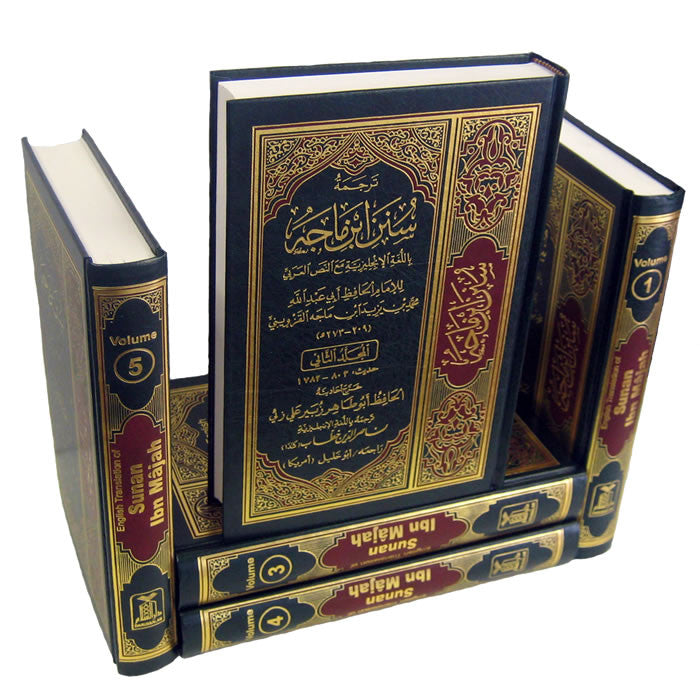

Sunan Ibn Majah contains 4,341 total Ahadith and is one of the six most genuine collections of the Ahadith. Dar-us-Salam Publications has taken great care in right translation, easy and comprehensible modern English language, and high quality publishing like the other translations of the six books of Hadith.
Ahadith in the book are followed by comments. The publisher has further added numerous features like section on how to benefit from Sunan Ibn Majah, about the Arabic and technical terms used, information about the hadith compilations and a glossary of Islamic terms in the last volume so as to assist readers further.
As regards the legitimacy, each hadith is also followed by its status which is explained in detail in the Arabic text. Also, the chain is complete in the Arabic text whereas it is removed from the English to decrease the length and not being of much advantage to the English readers.
Compiled by: Imam Muhammad Bib Yazeed ibn Majah Al-Qazwini
Ahadith edited and referenced by: Hafiz Abu Tahir Zubair Ali Zai
Translated by: Nasiruddin al-Khattab (Canada)
Final Review by: Abu Khaliyl (US)
Publisher's Forward
It is a well-known fact that the painstaking efforts of scholars gave Ahadith a high degree of reliability next to Qur'an. When the Ahadith had been read over carefully, revised, corrected and expounded in the light of the principles of Hadith sciences like Jarh (invalidation), Ta'dil (validation), and Asma'ur-Rijal, the stage for the recording of Ahadith was set. Thanks to the exhausting efforts of Hadith scholars and their deep sense of responsibility, the Muslim nation got, in addition to Sihah Sittah (the Sound Six books of Hadith) a vast treasure that included Musannafat (Hadith compilations according to subject-headings), Jawdmi' (comprehensive books of Ahadith), Sunan (collections of legal and doctrinal Ahadith), Masanid (Hadith compilations according to complete chains), Ma'ajim (compilations arranged according to names of Companions or regions or names of teachers of compilers), Mustadrakat (compilations of Ahadith meeting the conditions of other compilers but not found in their books), and Mustakhrajat (compilations containing Ahadith of other compilers with different chains of narration), the manuscripts of which numbering in thousands researched, edited and furnished with explanatory and marginal notes, exist even today in international libraries attracting the attention of research scholars. Anyhow, among those compilations, the six canonical books of Ahadith (Sihah Sittah) rank as the centerpiece.All the Ahadith of this collection have been documented, referenced and traced by the great research scholar, Hafiz Zubair 'Ali Za'i.The original Arabic texts of the Ahadith contain complete chain of narrators while in translation, for the sake of simplicity, only the name of the first narrator is mentioned who narrated the Hadith from the Prophet.
By: Imam Muhammad ibn Majah Al-Qazwini
Translator: Nasiruddin Al-Khattab
Pages: 2678
Binding: Hardback
Size: 6x9x6" (15x22 cm)
Format: Arabic-English+Commentary
ISBN: 9960-9881-3-9 (9960988139)
ISBN13: 9789960988139
Ibn Majah's Book: As-Sunan
During the era of the Prophet, Ahadith began to be put down in writing, but these were no better than compilations individuals. The only purpose for this was to put them down in writing, with: regard for order or sequence. Later on, during the caliphate of 'Umar bin 'Abdul-'Aziz (99 AH-101 AH), the state had taken on this task but most of the works in this field were the products of individual labor. The famous books like Muwatta of Imam Malik and Musnad of Imam Shafi were prepared during the second century of the Hijra calendar but Golden Age - the third stage recording Ahadith came only in the third century AH. In this age a lot of collections were made including the Six Books (Kutub Sittah), commonly known as the Sound Six (Sahah Sitta), Sunan of Ibn Majah being one of them and considered the last of them.
By the end of the fifth century AH, Sunan Ibn Majah began to be included in the Six Books. Ever since, it kept on growing worth and importance in every succeeding age. Sunan Ad Darimi, Sunan Ad-Daraqutni and other books of Sunan were superior to Sunan Ibn Majah with respect to soundness and strength but they did not gain popularity like Sunan Ibn Majah.
For denoting a book of Ahadith relating to legal rulings, a technical term Sunan, was used by Scholars of Hadith Science, from the Chapters of Purification down to the Chapter on Wills in the same order as followed in books of Islamic jurisprudence.
How important and useful the Sunan Ibn Majah is, can also be gauged the fact that when Ibn Majah showed his work to Imam Abu Zar'ah, the latter remarked: 'If this book reached the public, all or most of the existing Jawami would cease to be used. The words of Imam Abu Zar'ah proved be true to the last letter. Several Jawami, Musnads and Sunan were eclipsed by Ibn Majah's Sunan.
Hafiz Ibn Hajar termed the book Jami' Jaiyid (a good, comprehensive Hadith collection).
The book, As-Sunan by Imam Ibn Maajah was an outstanding and advantageous work that amazed the scholars of his time.
Back to Hadith books